The AOSR uses cookies on its site to make your browsing experience better. By clicking OK, you agree to our terms of use. To find out more, visit our cookie policy.
Do you stand on the tube side or the detector side, if you had a choice? The answer – the detector side, when access allows! And… occupational radiation protection starts before the first patient with shield placement changing the measured operator dose. In busy practices, all the more reason, preparation with planned positioning of staff/operators, shielding, pre-agreed manner of communication reminders with the team (such as the radiographer stating, the hand is approaching the field), will ensure optimal quality images with reduction of unnecessary irradiation. Having a specific standing group for fluoroscopy quality that that meets at least once every quarter and reporting to the radiation safety committee would be more effective, than just including fluoroscopic services as part of the general radiation safety committee.
During the question-and-answer session, some interesting and valid questions were fielded. For the interventional radiologist, if there were 3 measures before starting every fluoroscopic-guided procedure, what would the top 3 recommendations be? 1. Plan for the procedure. 2. Review actual radiation protection tools – shields, apron, eyeglasses and 3. Communications, including ensuring transparency and a safe “speak up” culture.
What about where to wear the personal dosimeter - outside or inside the lead apron? Wearing it outside would result in large overestimation whilst wearing it inside would underestimate the dose received. If possible, and available, then the best way is to wear more than one dosemeter. There are many algorithms available to combine the readings. However there was no harmonized regulations. There can be significant uncertainty in measurement of staff doses. There is background radiation to consider, calibration factors and more. For example, a dose of 100µSv in 1 month is actually between 50 and 140 µSv. The term reporting level may be more appropriate.
Measuring eye lens dose is even more challenging. Does one wear it on the forehead in the midline or a collar dosemeter? In interventional radiology, if the collar dosemeter is worn outside the lead gown, there were different correction factors published to convert this to the eye lens dose. Yet these vary, being very dependent on the type of procedure, personal habits, exact placement of the dosemeters, so that the difference in the ‘dose’ can be up to a factor of 10. When selecting eyeglasses, one also has to make sure it fits well such that the side and inferior edge does not have gaps.
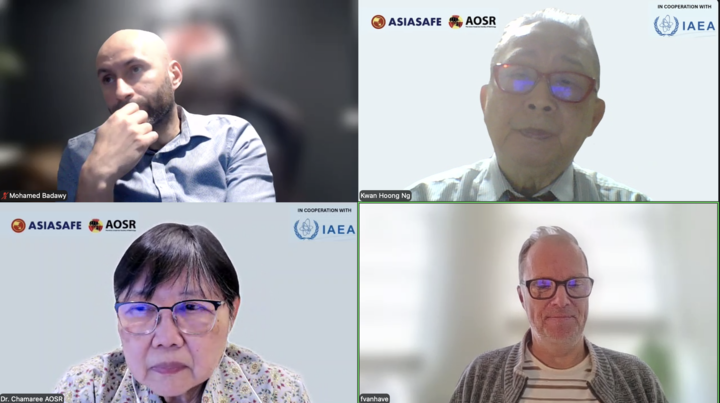
All these pearls, refresher and updated information about occupational radiation protection were expounded by two experts, one speaking for the IAEA and the other for the AOSR. The first speaker was Professor Filip Vanhavere, Head of Radiation Protection Dosimetry and Calibration expert group, Belgian Nuclear Research Centre, SCK CEN and Professor, Oncology Dept, University of Leuven, Belgium. He spoke on ‘Radiation Protection for Hospital Staff’. This was followed by occupational radiation protection in the clinical setting – ‘Protecting Staff in Fluoroscopy and Interventional Procedures’ by Associate Professor Mohamed Badawy, Chief Medical Physicist and Radiation Safety Officer, Monash Health Adjunct Associate Professor, Monash University, Australia.
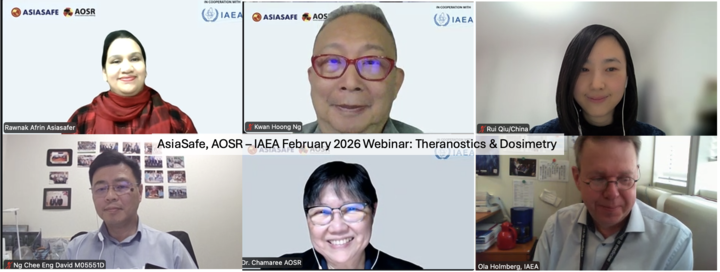
Watch past AsiaSafe, AOSR -IAEA webinars at youtube.com/@aosr